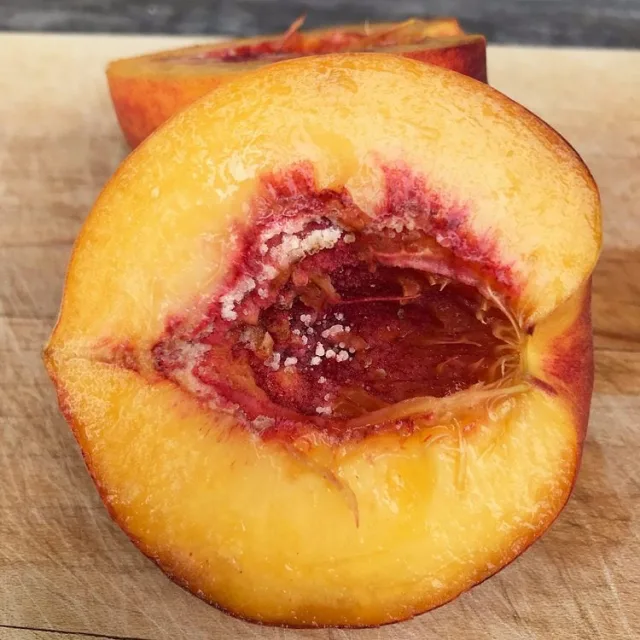
You slice open a peach. It looks perfect, golden, dripping, the kind you eat over the sink. And then you see it: a crusty, crystalline, faintly alien-looking white substance packed into the cavity around the pit.
Your brain immediately offers three theories, all of them terrible. Mold. Insect eggs. Some sort of chemical residue from the farm.
Take a breath. It's none of those. It has a name, it's completely natural, and, assuming a few conditions we'll get to, you can eat it.
It's called callus tissue
That white stuff is peach callus tissue, and the simplest way to understand it is this: it's a scab. Not a gross one. A plant one.
As a peach grows, the stone inside it hardens. Sometimes, especially in big, fast-growing, early-season fruit, the flesh expands faster than the pit can keep up with, and the pit cracks or pulls slightly away from the flesh. That leaves a gap inside a piece of fruit that very much does not want a gap inside it.
So the peach does what any living organism does with a wound: it patches it. It floods the area with undifferentiated cells, generic peach cells that haven't yet been told whether to become flesh, or skin, or stone. They pile up, fill the fissure, and seal the fruit off from bacteria and fungi trying to get in.
That pile of unassigned cells is what you're looking at. It's the peach's own emergency bandage, and the fact that it's there means the fruit successfully defended itself.
Why it looks so unsettling
Callus tissue is a shapeshifter, which is exactly why it triggers alarm. It can show up as:
Crystalline or sugar-like granular white crusts clinging to the walls of the pit cavity, like someone sprinkled coarse sugar in there
Cottony a small, dense white tuft, which is the one people most often mistake for mold
Web-like fine pale threads stretched across the cavity
Waxy and solid, a smooth compact deposit filling the crevices of the stone
It's most dramatic in split-pit peaches, where the stone has genuinely cracked open. That's not a defect in the fruit's edibility, it's just a peach that grew a little too enthusiastically, usually a large, early-ripening variety after a wet spell.
Callus vs. mold: how to tell in five seconds
This is the part that actually matters, because a moldy peach and a callused peach are not the same thing and you should be able to tell them apart without a microscope.
It's callus tissue (safe) when:
It's only around the pit or the pit cavity it doesn't spread out into the flesh
It's white, off-white or pale cream never blue, green, grey or black
It looks crystalline, firm, cottony or waxy, not fuzzy
The flesh around it is firm, fragrant and tastes normal
It smells like a peach, or of nothing at all
It's mold (toss it) when:
The growth is fuzzy or powdery and looks like it's spreading
You see colour green, blue-grey, black, dusty white fuzz
It appears on the flesh, on bruises, near the stem, or on broken skin, not just at the stone
The flesh nearby is mushy, brown, translucent or wet
It smells sour, boozy or fermented
Here's the food-safety rule people get wrong: with mold in a soft fruit, you don't cut around it. You throw the whole peach out. Mold in soft, high-moisture flesh sends invisible threads well beyond the visible patch, and some molds produce toxins. Trimming off the fuzzy bit and eating the rest is a bad trade. A peach costs less than a rough night.
Callus tissue, by contrast, requires no action at all. It's tasteless. It doesn't change the flavour. You can eat it, scoop it out, or ignore it entirely.
So can you eat it? Yes.
Agricultural extension services have been answering this question for decades, and the answer hasn't changed: callus tissue is not a fungus, not a bacterium, not a disease, and not harmful. It occurs naturally and it can be eaten along with the rest of the fruit.
It isn't a sign that the peach was sprayed with something. It isn't a sign that it's old. It isn't a sign that it was grown badly. It's a sign that the fruit was alive and doing biology right up until the moment you took a knife to it.
One thing you actually shouldn't eat
While we're inside the peach: leave the kernel alone. If you crack the stone open, you'll find a soft almond-shaped seed inside. It looks edible. It's a close relative of the almond, and some cuisines do use bitter kernels in tiny, controlled quantities.
But peach and apricot kernels contain amygdalin, a compound the body can convert into cyanide. A single accidental nibble isn't going to hurt you. Eating them regularly, or in quantity, is a genuinely bad idea, and no, they are not a cancer cure, whatever the internet told you.
Eat the flesh. Compost the stone. Or plant it, if you're feeling patient: it needs a cold winter to germinate, it'll take three to five years to fruit, and the peaches probably won't taste like the one you're holding. Nature doesn't do copy-paste.
The takeaway
The white stuff in your peach is the least sinister thing in your kitchen. It's a wound that healed. The fruit cracked itself, sealed itself, and ripened anyway, and then you cut it open and got suspicious of the scar tissue.
Check for fuzz. Check for smell. Check that the flesh is firm. If it passes, stop googling and eat the peach.