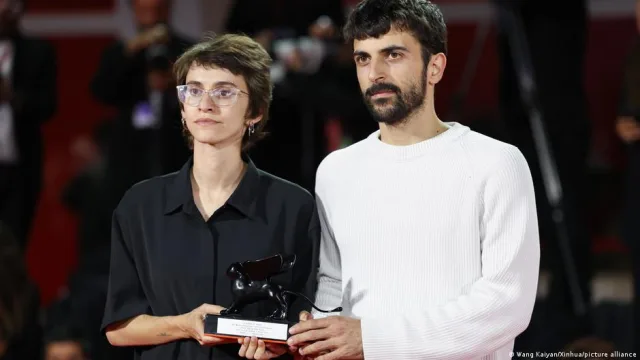
Israeli Prime Minister Benjamin Netanyahu has condemned the documentary 'NAZA', calling it "shocking" and accusing it of fueling global antisemitic incitement. In a video address posted on Telegram, Netanyahu said: "We are fighting global antisemitic incitement and when it comes from within us it is intolerable. And now two Israeli directors portraying the IDF as war criminals receive applause at the Venice festival."
The film, directed by Israeli journalists Yuval Abraham and Rachel Szor, won the Special Jury Prize at the 83rd Venice International Film Festival on September 13 (some sources say September 12). It received a record-breaking 25-minute standing ovation during its screening on September 10. The 80-minute documentary is based on anonymous interviews with 24 Israeli military intelligence officers, soldiers, and whistleblowers who describe the systems behind Israel's targeting of Palestinian civilians in Gaza. The title 'NAZA' is an acronym for "Nezek Agavi," an Israeli military term for expected collateral damage the number of civilians anticipated to be killed in an airstrike.
Political Backlash and Threats to Revoke Citizenship
Israeli Culture and Sports Minister Miki Zohar called the film "vile" and announced he would act to revoke the Israeli citizenship of Abraham and Szor, accusing them of "treason against the state." On Monday, Zohar said he had written to the director general of the Population and Immigration Authority and the interior ministry, asking them to examine the possibility of revoking citizenship for "breach of loyalty to the state and collaboration with the enemy." He also requested an investigation into how the filmmakers obtained their materials and whether any actions amounted to assisting the enemy during wartime. "Freedom of expression is not a licence to betray the state," Zohar stated.
National Security Minister Itamar Ben-Gvir described the directors as a "disgrace and an embarrassment" and told them to leave the country, writing on X: "I am certain that your friends, that is to say our enemies Hamas in Gaza, will welcome you with open arms." Former Defence Minister Avigdor Lieberman called them "haters of Israel," and former Prime Minister Naftali Bennett described the film as "a horrific blood libel against our sons and daughters."
The revocation of nationality is legally possible in Israel, though rarely applied. In 2022, the Supreme Court confirmed that the state may strip individuals of their nationality for failing to show "loyalty," such as committing espionage or treason. The law was expanded in 2023 to apply to those convicted of "terrorism." The process requires the interior minister to submit the request, the justice minister to approve it, and judges to validate it.
Military Response and Legal Examination
Israel Defense Forces Chief of the General Staff Eyal Zamir condemned the film, saying it is "based on blood libels, deliberate distortions of reality and grave, false accusations against IDF soldiers and commanders." He instructed the military advocate general to examine possible legal measures regarding the film and those involved. Zamir also ordered an examination of information-security issues and an investigation into whether classified material was leaked for the film's production. He further directed the formation of a multi-agency team, headed by the army's Planning Directorate, to develop mechanisms for responding to what the military calls "false allegations."
Zamir later clarified that he had not watched the film and did not know the interviewees or sources. He added that the allegations had not been presented to the military, making it difficult to respond seriously. The military had requested access to the full film to review and provide a detailed response, after its initial position was based on clips and promotional material.
The IDF rejected allegations that artificial intelligence is used to make decisions on airstrikes, insisting that target selection and strike approval are made by humans. It specifically denied an allegation from the film's promotional material about a planned strike expected to kill 500 civilians, saying it had not planned, approved, or carried out any such strike. The military also questioned whether some sources were in a position to know details of national and military strategy, and said some cases involved operations in which the Intelligence Directorate members interviewed would not have been involved.
Film Details and International Reaction
'NAZA' was produced by The Guardian and JW Films, and builds on reporting between 2023 and 2025 published by +972 Magazine, Local Call, and The Guardian. It was shot in secrecy at night on rooftops in Tel Aviv over nearly three years. The interviewees' faces and voices were digitally altered to protect their identities. In one interview, a source claims that approval was given to kill 500 NAZA in order to kill one Hamas member.
When accepting the award, Yuval Abraham said: "We believe that the denial of a crime is what helps it persist and this is why it is especially important for us that Israelis watch this film, it is our country that is doing these crimes."
The directors previously won an Oscar in 2025 for their film 'No Other Land', which focused on Israeli settler violence against Palestinian communities in the occupied West Bank. Abraham's family home was targeted by a rightwing mob after that film's premiere. He told The Guardian: "We're taking risks in a system that privileges us, that has Jewish-Israeli supremacy as its founding characteristic. For so many Palestinians, it's not a rightwing mob that's coming to their home: it's US-funded bulldozers and weapons."
The Guardian defended the film, with a spokesperson saying: "The Guardian is disturbed to see the authoritarian response to NAZA in Israel. Yuval Abraham and Rachel Szor are brave journalists and film-makers. The attacks against them come from people who have not yet seen the film. NAZA is based on more than three years of investigative journalism. The testimonies it contains are true and we believe they deserve to be heard. The interviews were given by confidential journalistic sources. We will robustly defend NAZA – and the team behind it – from any attacks or attempts at censorship."
Some Israeli figures praised the film. Former lawmaker Yousef Jabareen, chair of the leftwing Hadash party, congratulated the directors, thanking them for bringing "these horrific crimes and the brutal reality in Gaza" before millions. Anat Saragusti, head of press freedom at the Union of Journalists in Israel, said: "The Israeli public has not received anything close to adequate coverage in Hebrew of what has happened in Gaza. For much of the war, Israeli media barely showed the Palestinian side of the story – the civilian casualties, the children killed, the destruction."
In an editorial, Haaretz urged Israelis to confront the reality of Israel's actions in Gaza, writing: "By screening their film at the Venice film festival, Abraham and Szor are trying to force Israelis to confront what they already know: that there's a black stain on the way Israel is conducting war in Gaza, to put it mildly."
The controversy comes amid the ongoing war in Gaza, which began after Hamas launched an attack on Israel on 7 October 2023, killing 1,221 people and taking 251 hostages, according to Israeli figures. The Gaza health ministry reports more than 73,000 deaths in the subsequent three years of Israeli bombardment, the vast majority civilians. Organizations including Amnesty International, Human Rights Watch, and the United Nations have described Israel's actions as "genocide," and a June UN report found that Israeli forces deliberately targeted Palestinian children, resulting in genocide and atrocity crimes.
'NAZA' will screen at the San Sebastián International Film Festival on 23 September and at the New York Film Festival on 26 September. No official theatrical release date has been announced, but French distributor MK2 Films holds world sales rights.