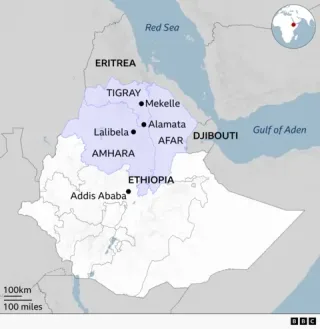
Ethiopian federal forces and allied militias entered Mekelle, the capital of the northern Tigray region, on Saturday, October 3, 2026, after the Tigray People's Liberation Front (TPLF) announced a withdrawal from the city, marking a dramatic turn in a conflict that has already shattered the 2022 Pretoria peace agreement and severed diplomatic ties between Ethiopia and Eritrea.
The TPLF said in a statement late Saturday that it had "temporarily moved out of Mekelle" to "operate from somewhere else", according to Al Jazeera. A source close to the pro-government Tigray Peace Force told Reuters that its fighters entered central Mekelle on Saturday afternoon, followed by the Ethiopian military. Residents reported celebratory gunfire overnight into Sunday morning, and a local journalist told AFP that federal troops were patrolling the city and manning key institutions as communications were restored for the first time in more than a week.
The fall of Mekelle caps a rapid federal counter-offensive that reversed early rebel gains. The TPLF and its allies, operating under the banner of the Ethiopian Peoples' Forces Alliance for Survival, launched attacks on September 23, seizing three airports in Tigray and pushing into the neighbouring Afar and Amhara regions. At least 52 civilians were killed in three days of fighting around the town of Alamata, a doctor told the BBC. But pro-government forces retook Alamata, then advanced along three axes toward Mekelle, recapturing the Alula Aba Nega airport roughly 10 km from the city centre before entering the capital itself.
A diplomatic rupture with deeper roots
The battlefield reversal has not calmed the wider crisis. On Thursday, October 1, Ethiopia closed its embassy in Asmara and ordered 10 Eritrean diplomats to leave within 48 hours, accusing them of "involvement in activities that pose a direct threat to Ethiopia's national security", the Associated Press reported. Eritrea responded by severing all diplomatic ties, saying it had "no option but to reciprocate in kind", and warned of "negative corollaries" from the decision.
The rupture is the sharpest deterioration in relations since Prime Minister Abiy Ahmed's 2018 rapprochement with Eritrean President Isaias Afwerki, which helped earn Abiy the 2019 Nobel Peace Prize. During the 2020-2022 Tigray war, Eritrean forces fought alongside Ethiopian federal troops against the TPLF. That alliance has now inverted: Addis Ababa accuses Asmara of backing the rebel coalition, while Eritrea denies any involvement and says Abiy is externalising an internal conflict.
At the heart of the dispute is Ethiopia's quest for direct access to the Red Sea, lost when Eritrea gained independence in 1993. Abiy has repeatedly argued that sea access is vital to Ethiopia's long-term economic and security interests, statements that officials in Asmara interpret as a threat to seize the port of Assab. TPLF leader Debretsion Gebremichael framed the stakes bluntly in a video published late Thursday, saying "the war is regional and it is a war to control the Red Sea", according to France 24.
A counter-bloc forms in Egypt
The conflict is now pulling in Ethiopia's other neighbours. On Sunday, October 4, Egyptian President Abdel Fattah el-Sisi hosted a quadrilateral summit in New Alamein with Eritrea's Afwerki, Somali President Hassan Sheikh Mohamud and Sudan's Sovereign Council Chairman General Abdel Fattah al-Burhan. The resulting El-Alamein Joint Declaration adopted common positions on Red Sea governance, Nile waters and the sovereignty of regional states, according to Ethiopian Business View.
The declaration stated that governance of the Red Sea is the exclusive responsibility of its littoral states, a position aimed squarely at landlocked Ethiopia's maritime ambitions. On the Nile, the four leaders rejected "unilateral measures" affecting the existing water uses of Egypt and Sudan, an implicit rebuke of Ethiopia's Grand Ethiopian Renaissance Dam. They also agreed to establish a follow-up mechanism and hold the summit periodically, potentially creating a permanent coordination framework among the four countries.
The summit followed a week of tit-for-tat diplomatic expulsions. Ethiopia expelled an Egyptian diplomat without explanation, prompting Cairo to order an Ethiopian embassy official to leave within the same period. Egypt denies supporting the TPLF, and Eritrea says Abiy is trying to externalise an internal conflict. But the optics of four of Ethiopia's neighbours meeting in Egypt, days after Asmara severed ties, signal a hardening of regional alignments.
What happens next
Analysts are divided on whether the conflict will escalate into a direct Ethiopia-Eritrea war, but few dismiss the risk. Laura Hammond, professor in development studies at SOAS University of London, told Al Jazeera that "there is a strong possibility that Eritrea will become more involved in the conflict on the ground inside Tigray if it continues much longer". Martin Plaut, an analyst specialising in the Horn of Africa, said there was a "real danger" of the conflict spreading, warning that "it would only require a spark to ignite a conflagration" engulfing Ethiopia, Eritrea and Sudan.
Magnus Taylor of the International Crisis Group told The Eastleigh Voice that Eritrean involvement in the latest fighting is plausible, suggesting Asmara has used the TPLF and other opposition groups "to deter the perceived risk of Ethiopian aggression, whether that's for access to the port or other reasons". The Critical Threats Project, part of the American Enterprise Institute, reported that Eritrea has implemented a nationwide military mobilisation and maintained an enhanced posture on the Ethiopia-Eritrea border since early 2025, and that Eritrean forces may already be present in northern Ethiopia.
There are also signs the conflict is straining Ethiopia's military commitments elsewhere. Bloomberg reported that Ethiopia is preparing to withdraw more than 3,000 troops from Somalia, where they have been a key part of the fight against al-Shabab, to redeploy them to the northern front. A Somali defence ministry official said Mogadishu had not been informed of any such plan.
The humanitarian picture is deteriorating rapidly. The United Nations has warned that drone activity and air strikes are putting civilians, vital infrastructure and aid operations at risk, while insecurity and road closures are restricting humanitarian movements. Amnesty International said on Friday it had received "credible reports of destruction of civilian objects through shelling and air strikes, intensified forced conscription, and other acts that may constitute violations of international humanitarian law".
The African Union has urged Ethiopia, Eritrea and Egypt to exercise maximum restraint, and the US State Department warned on October 3 that increasing tensions "have the potential to affect the entire region". But with the TPLF vowing to continue fighting from outside Mekelle, Eritrea mobilised and a four-nation bloc forming in Egypt, the question is no longer whether the Horn of Africa will be destabilised, but how far the shockwaves will travel.