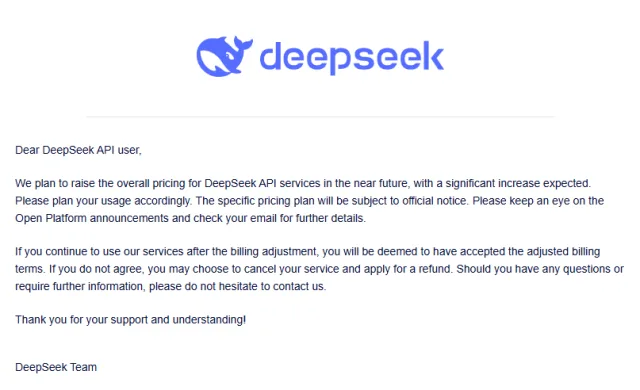
Chinese artificial intelligence startup DeepSeek notified its API customers on Thursday, August 6, 2026, that it plans a "significant" across-the-board price increase in the near future, a striking reversal for the company that ignited a global AI price war with rock-bottom rates. The warning, published on its developer platform, comes amid a turbulent month in which the company paused a $7.4 billion second funding round, then quietly restarted it, while its newest model surged to the top of global usage rankings.
The Price Hike Notice
On Thursday, DeepSeek posted a brief but blunt notice on its developer documentation page. The company told users to "plan your usage accordingly" and warned that the increase would be substantial, though it published no new rate schedule and specified no effective date. The notice stated that users who continue using the service after the billing adjustment "will be deemed to have accepted the adjusted billing terms" and that those who disagree may cancel and apply for a refund.
The Hangzhou-based company's current pricing distinguishes between input and output tokens, as well as cached and uncached requests. Its V4 Flash model, the lightweight workhorse that has driven much of its recent growth, is priced at approximately $0.14 per million input tokens (cache miss) and $0.28 per million output tokens - rates that have made it, by some measures, the cheapest capable AI model available globally.
The announcement, reported by the South China Morning Post, The Next Web, TechNode and others, landed just one week after the company released DeepSeek-V4-Flash-0731, a 284-billion-parameter lightweight model that had been promoted as one of the cheapest capable options available anywhere.

The Funding Rollercoaster
The price hike warning is only the latest in a sequence of events that has drawn intense scrutiny to DeepSeek's financial position. The timeline is compressed and dramatic:
Mid-June 2026: DeepSeek closes its first-ever external funding round, raising approximately $7.4 billion (50 billion yuan) at a valuation exceeding $50 billion. Investors include Tencent, battery giant CATL, JD.com, NetEase, and China's National Artificial Intelligence Industry Investment Fund. Founder Liang Wenfeng personally commits roughly $3 billion of his own money, according to Reuters.
Mid-July 2026: DeepSeek begins talks for a second funding round targeting at least 10 billion yuan (approximately $1.5 billion) at a pre-money valuation of 480-500 billion yuan ($71-$74 billion), a roughly 42% jump from the June round, according to Bloomberg and the Financial Times.
Late July 2026: DeepSeek abruptly pauses the second funding round. Bloomberg reports that founder Liang Wenfeng was frustrated by leaked online reports of comments he made during private investor meetings. The company verbally informs prospective backers that expected investment agreements would not be signed.
August 5, 2026: Chinese financial outlet Caijing reports that DeepSeek has quietly restarted the second round, still targeting 50 billion yuan at a pre-money valuation of approximately 500 billion yuan, with signing expected by late August. Some investment institutions say they have not yet received formal notice of the restart.
August 6, 2026: DeepSeek announces the significant API price hike.
If the second round closes as reported, DeepSeek will have raised over 100 billion yuan (approximately $14.8 billion) across two funding rounds - a record for China's AI industry.
Why Demand Is Breaking the Model
The price hike is not happening in a vacuum. DeepSeek's V4 Flash model has become a runaway success. According to OpenRouter, the multi-model aggregation platform, V4 Flash processed 7.22 trillion tokens in the week of July 27 to August 2, 2026, ranking first globally among all AI models. On August 1 alone, the OpenCode platform recorded 8 trillion tokens of V4 Flash traffic - 5 trillion from free trials and 3 trillion paid by developers, TechNode reported.
On August 4, the V4 Flash API experienced a capacity outage from what Pandaily described as "unprecedented" demand. The surge has a clear financial consequence: every token served costs real money in chips and electricity, and DeepSeek's ultra-low pricing means the company may be losing money on every query.
DeepSeek had already been experimenting with cost-recovery mechanisms. In mid-July, it introduced a "peak-valley pricing" mechanism - the first time the company installed what one Chinese tech outlet called "a metering system for its computing power." Under that system, V4 Pro costs $0.87 per million output tokens during off-peak hours but $1.74 during peak hours. The new across-the-board increase, however, "lifts the floor" rather than merely rationing peak demand, according to Pandaily's analysis.
The Leaked Transcript That Upended Everything
The funding pause in late July was triggered by an extraordinary leak. A transcript of a nearly four-hour closed-door meeting Liang Wenfeng held with prospective investors in May 2026 began circulating on Chinese social media. The document, whose authenticity DeepSeek has not confirmed, gave the industry its clearest look yet inside the mind of the reclusive founder.
According to the South China Morning Post, Liang repeatedly emphasized "restraint" as a core company vision - a philosophy reflected in DeepSeek's open-source model and affordable pricing. But he also delivered candid assessments that struck a sensitive nerve. He reportedly said China remains 12 to 18 months behind the United States in AI sophistication, that the gap ultimately traces back to differences in compute resources, and that DeepSeek remains dependent on Nvidia chips despite US export controls.
Those remarks, Bloomberg reported, directly countered the heavily promoted domestic narrative that China's AI sector has already closed the gap with Silicon Valley. Liang was reportedly frustrated by the leak, and DeepSeek informed some would-be backers that investment agreements would be delayed.
Yet the pause proved brief. Within roughly ten days, the round was back on, with Caijing reporting on August 5 that DeepSeek and its investors "hope this funding round will proceed quietly after its restart."
Context: From Price War to Cost Reckoning
DeepSeek is not alone in confronting the brutal economics of cheap AI. The entire Chinese AI sector is rotating from a "lowest price wins the user" playbook toward what Pandaily called a "sustainable cost recovery" model. Zhipu AI's API pricing rose 83% year over year in Q1 2026. ByteDance's Doubao Pro introduced a three-tier subscription in June. In July, Moonshot AI's Kimi paused new consumer sign-ups after K3 launch traffic exceeded its cluster capacity within 48 hours.
The competitive landscape has also shifted. When DeepSeek first stunned markets in January 2025 with models that matched Western performance at a fraction of the cost, its pricing advantage was overwhelming. Today, Western rivals have narrowed the gap. AI developer Michael Guo questioned the timing of the price hike in a social media post on Thursday, arguing that new American models including Meta's Muse Spark and OpenAI's GPT-5.6 Luna were now competitive with DeepSeek on both capability and price, the SCMP reported.
"DeepSeek choosing to raise prices at this time - isn't this just asking for trouble?" Guo wrote.
Meanwhile, DeepSeek is pursuing an extraordinarily capital-intensive expansion. The company is planning a 1-gigawatt data center in Ulanqab, Inner Mongolia, with partial operations targeted for late 2027 or early 2028, Forkast reported. It is also developing its own AI inference chip to reduce dependence on Nvidia and Huawei hardware. And it is preparing for an IPO on Shanghai's STAR Market, with a filing targeted for late 2026 and a debut expected in 2027, according to Reuters.
Forkast reported that DeepSeek's annualized revenue is nearing $500 million, with gross margins of 70-80% on cloud access. Those are healthy figures for a software company, but they must be weighed against the staggering capital requirements of building 1GW of AI infrastructure - a project that Nvidia CEO Jensen Huang has estimated could cost $50 billion for a facility equipped with cutting-edge accelerators.
Why It Matters
The price hike and the funding turbulence matter for three reasons beyond DeepSeek itself.
First, it tests the sustainability of the entire low-cost AI model. DeepSeek built its global reputation on proving that frontier AI did not require Silicon Valley-sized budgets. If even the price leader must raise rates, it suggests the economics of serving AI at scale are more punishing than the "DeepSeek moment" narrative acknowledged.
Second, it signals a broader industry pivot. The era of AI subsidized to near-free for users may be reaching its limits. As The Next Web put it, "coming from the company that set the pace of the price war, even a warning is enough to make the whole market recalculate."
Third, it exposes tensions in China's AI strategy. Liang's leaked comments about China's continued dependence on US chips and its 12-18 month technology gap cut against official narratives of self-sufficiency. The fact that the funding round survived that leak - and restarted within days - suggests that state-backed investors remain committed, but the episode revealed the political sensitivities that Chinese AI champions must navigate.
Competing Interpretations
Analysts and industry observers are divided on what the price hike and funding drama actually signal.
The growth-pain interpretation: DeepSeek is a victim of its own success. V4 Flash's explosive adoption - 7.22 trillion tokens per week - has overwhelmed its compute capacity. The price hike is a rational response to demand exceeding supply, not a sign of financial distress. The rapid restart of the second funding round, at a higher valuation, suggests investor confidence is intact.
The cash-crunch interpretation: The sequence of events - a paused funding round, a hastily restarted round, and an urgent price hike - looks like a company scrambling to shore up its finances. DeepSeek may be burning through its June capital faster than anticipated, especially given the enormous infrastructure commitments it has made. The price hike is a revenue bridge while it closes the new round.
The IPO-readiness interpretation: DeepSeek is preparing for a public listing and needs to demonstrate a path to sustainable economics. Raising prices and securing a second round at a higher valuation both improve the narrative for public-market investors. The price hike is less about immediate need than about telling a credible profitability story.
It is important to note what is not in evidence. No credible reporting has suggested DeepSeek is insolvent, unable to meet payroll, or facing a collapse. The company just raised $7.4 billion in June and is in active talks for another $7.4 billion. Its models dominate global usage rankings. Its annualized revenue is reportedly approaching $500 million. The picture that emerges from available reporting is of a company under acute cost pressure and growing fast enough to strain its infrastructure - not one on the brink of failure.
What Happens Next
Several developments are likely in the coming weeks and months:
New pricing schedule: DeepSeek said the specific pricing plan will be subject to official notice. Developers and enterprise customers will be watching closely for the magnitude of the increase and whether it applies uniformly or varies by model tier.
Second funding round close: Caijing reported that signing is targeted for late August. If the round closes at the reported 500 billion yuan valuation, it will confirm that institutional investors see the price hike as a sign of pricing power rather than desperation.
Competitor response: Rivals including Moonshot AI, Zhipu, and ByteDance's Doubao will have an opening to pitch themselves as the new low-cost option. Western labs may also see an opportunity to win back price-sensitive developers.
IPO filing: DeepSeek is targeting a filing by the end of 2026, according to Reuters. The financial reports it prepares for that process will provide the first public look at its actual revenue, costs, and burn rate.
Infrastructure milestones: Progress on the Ulanqab data center and the in-house inference chip will indicate whether DeepSeek can bring its compute costs under structural control, rather than relying on pricing adjustments alone.
For now, the price hike is a signal rather than a number. But coming from the company that defined the AI price war, even a warning shot is enough to reshape expectations across the industry.
FAQ
Is DeepSeek going bankrupt or facing financial collapse?
No credible reporting supports that conclusion. DeepSeek raised $7.4 billion in June 2026 and is in active talks for a second round of similar size. Its models dominate global usage rankings. The price hike and funding pause reflect cost pressures and rapid growth, not insolvency.
How much will DeepSeek's API prices increase?
DeepSeek has not published a new rate schedule. The company said only that the increase would be "significant" and across-the-board. Specific figures are expected in a formal notice.
When will the new prices take effect?
No effective date has been announced. DeepSeek said the increase would land "in the near future" and advised users to monitor official platform announcements and email.
Why did DeepSeek pause its second funding round?
According to Bloomberg, the pause was driven in part by founder Liang Wenfeng's frustration over leaked online reports of comments he made during private investor meetings. The round was restarted within approximately ten days.
Is DeepSeek going public?
DeepSeek is preparing for an IPO on Shanghai's STAR Market, with a filing targeted for late 2026 and a potential debut in 2027, according to Reuters. The timeline is subject to change and regulatory approval.